.svg)
Adrienne Sanders

Immigration Attorney Serving Greater Louisiana and United States Adrienne Sanders is an immigration law attorney at Rozas Law Firm whose practice is informed by a broad understanding of law, international affairs, and the social factors that can shape an individual’s legal circumstances. She focuses heavily on refugee and asylum law, helping clients navigate complex immigration…
Read MoreWilliam M. Rolfe

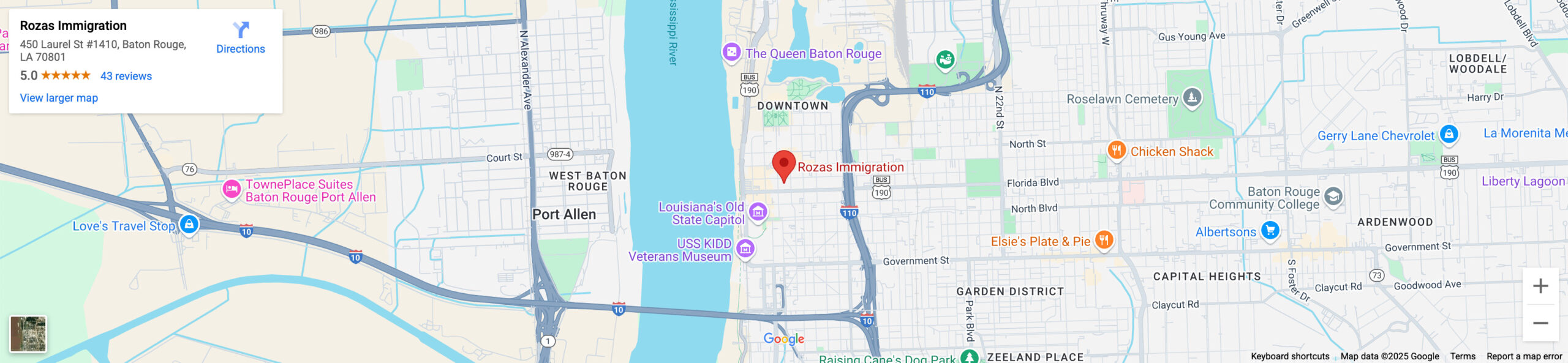
Immigration Attorney Serving Greater Louisiana and United States William M. Rolfe is an immigration law attorney at Rozas Law Firm in Baton Rouge, Louisiana, where he focuses his practice on immigration and nationality law. His decision to practice immigration law grew from his experiences volunteering with and living among migrant communities in Memphis, Tennessee. Before…
Read MoreKenneth A. Mayeaux

Immigration Attorney Serving Baton Rouge and Greater Louisiana Kenneth A. Mayeaux has been practicing law since 1986 and has dedicated much of his career to helping individuals and families navigate complex legal challenges. As the founder of Mayeaux & Associates L.C., Mr. Mayeaux built a practice focused on serving immigrant communities and helping families pursue…
Read MoreShould I speak with an immigration attorney before filing for a green card?

Yes. Because Adjustment of Status is now being reviewed with greater discretion and consular processing may be required in more cases, applicants should speak with a licensed immigration attorney before filing, like David Rozas or an attorney with Rozas Law Firm. An attorney can help evaluate eligibility, immigration history, possible risks, and the most appropriate…
Read MoreWhat does “extraordinary” mean for Adjustment of Status?
USCIS cited immigration case law describing Adjustment of Status as an “extraordinary” form of relief because it allows certain applicants to seek permanent residency without following the ordinary consular visa process. Whether an applicant qualifies depends on the facts of the case, eligibility requirements, and USCIS discretion. (USCIS)
Read MoreWhat is consular processing?
Consular processing is the process of applying for an immigrant visa through a U.S. embassy or consulate outside the United States. Under the recent USCIS policy update, this pathway may become more important for many green card applicants who previously expected to apply from inside the United States. (USCIS)
Read MoreDo I need to leave the United States to apply for a green card?
Not necessarily. Some applicants may still qualify for Adjustment of Status, but USCIS has stated that this form of relief is discretionary and should be evaluated case by case. TIME reported that many people applying from inside the United States may now face greater pressure to complete processing through U.S. consulates abroad. (USCIS)
Read MoreHas USCIS changed how Adjustment of Status is reviewed?
Yes. USCIS announced a policy update stating that Adjustment of Status is a discretionary benefit and that officers must review each case based on the full facts and circumstances. USCIS also emphasized that consular processing through the Department of State is the regular process for many applicants seeking immigrant visas. (USCIS)
Read More