.svg)
When Your Asylum Case Goes to Immigration Court: What a Referral Actually Means

You filed Form I-589 almost two years ago. You sat in the waiting room at the asylum office. You answered every question an officer asked about the night the men came to your house, and about why you could not go to the police.
Then an envelope came. It did not say approved. It said your case had been referred to an immigration judge, and clipped behind it was a Notice to Appear with a courtroom and a date.
Your mother read the word “referred” and heard the word “deported.” It is not over. A referral means your case moved, not that it was decided against you. Here is what happens next.
The Two Tracks: Affirmative and Defensive
Affirmative asylum is what you do on your own initiative. You file Form I-589, Application for Asylum and for Withholding of Removal, with U.S. Citizenship and Immigration Services. An asylum officer interviews you in an office, not a courtroom. Nobody argues against you.
Defensive asylum is the same claim raised as a defense in removal proceedings before an immigration judge at the Executive Office for Immigration Review, or EOIR. Same form. Same story. Entirely different setting.
Some people start defensively, placed in removal proceedings first after an encounter with immigration enforcement. Others start affirmatively and land in court by referral.
A Referral Is Not a Denial
This is what families get wrong most often.
When an asylum officer does not grant an affirmative application and the applicant has no other lawful status, the officer does not deny the case. USCIS issues a Form I-862, Notice to Appear, and refers the case to an immigration judge. Those are the agency’s own words.
A denial closes a door. A referral opens a different one. Your claim has not been finally rejected. It has been handed to a decision maker who must look at it again.
If you held a valid status at the time, USCIS may issue a notice of intent to deny instead.
The Judge Starts From Zero
The immigration judge reviews your claim de novo, meaning anew. USCIS describes it plainly: the judge conducts a new hearing and issues a decision that is independent of the decision made by USCIS.
The judge is not reviewing the asylum officer’s work for error. The judge decides your claim from the beginning, on the record built in court. A case that stalled at the asylum office over a credibility concern, a missing document, or a legal theory the officer rejected gets a completely fresh look.
What Changes: Now Someone Argues Against You
Your asylum interview was not adversarial. Immigration court is. An attorney for the Department of Homeland Security appears in the courtroom, and that attorney’s job is to oppose your application. Under the EOIR policy manual, both sides present evidence, raise objections, and cross examine the other side’s witnesses.
That lawyer has your file, the I-589 you signed, and often the asylum officer’s notes. They will read all of it looking for daylight between what you wrote, what you said at the interview, and what you say from the witness stand. That is a reason to prepare, not a reason to panic.
Master Calendar Hearing Versus Individual Hearing
Immigration court runs on two kinds of hearings.
The master calendar hearing is short and procedural, with several cases on the docket at once. Under the EOIR policy manual, the judge advises you of your right to a lawyer at no expense to the government, you plead to the Notice to Appear by admitting or denying the allegations and the charge of removability, you state what relief you seek, and the court sets deadlines. You may be in the room only a few minutes. Be represented anyway, because what you concede here binds you later.
The individual hearing, also called the merits hearing, is your trial. You testify under oath. Your witnesses testify. The DHS attorney cross examines. Both sides give opening and closing statements and object to the other side’s evidence. The judge may rule orally or issue a written decision later.
⚠️ Filing deadlines before an individual hearing are set by the court and by local operating procedures, and they vary. Verify the deadlines for your hearing with your attorney.
The One Year Filing Deadline
Under INA 208(a)(2)(B), codified at 8 U.S.C. 1158, an applicant must show by clear and convincing evidence that the application was filed within one year after arriving in the United States. ⚠️ Confirm how this statutory deadline applies to your arrival and filing dates with counsel. The government will raise timeliness if there is any question about it.
INA 208(a)(2)(D) provides two escape valves: changed circumstances that materially affect eligibility for asylum, or extraordinary circumstances relating to the delay in filing.
The regulation at 8 C.F.R. 1208.4 fills those in. Changed circumstances include worsening conditions in your country, changes in your own situation or in United States law, and losing dependent status on someone else’s application. Extraordinary circumstances include serious illness, legal disability, ineffective assistance of counsel, and holding another lawful status until shortly before filing. ⚠️ Verify the current regulatory text before relying on any exception.
Both carry a condition people miss. You must still file within a reasonable period given those circumstances.
Consistency Is the Case
Congress wrote the credibility standard into the statute, at 8 U.S.C. 1158(b)(1)(B)(iii). A judge may consider your demeanor and responsiveness, the plausibility of your account, the consistency between your written and oral statements, and how it all lines up with other evidence including State Department country conditions reports.
Then comes the sentence that decides cases. The judge may consider an inconsistency, inaccuracy, or falsehood without regard to whether it goes to the heart of your claim.
A date you got wrong on the I-589. A detail you described one way to the asylum officer and another way in court. That is the raw material of cross examination.
The statute also says your testimony alone can carry the burden if it is credible, persuasive, and specific, but that the judge may require corroboration unless you cannot reasonably obtain it.
Withholding of Removal and Protection Under the Convention Against Torture
Your Form I-589 preserves two related forms of protection, and in court they matter.
Withholding of removal under INA 241(b)(3) requires showing it is more likely than not that you would be persecuted on account of a protected ground. Protection under the Convention Against Torture requires showing it is more likely than not that you would be tortured if removed.
Both standards sit higher than asylum’s well founded fear standard, which requires only a reasonable possibility of persecution. But they are not subject to the one year deadline, and some applicants barred from asylum remain eligible. They also give you less: no permanent residence, no ability to petition for family. A well built case presents all three.
Employment Authorization
Under 8 C.F.R. 208.7, an applicant may file for employment authorization 150 days after a complete asylum application is received, and none may be issued before 180 days have run from that filing. ⚠️ These figures come from the current regulation, but asylum employment authorization rules have been litigated and amended repeatedly. Verify current requirements with USCIS or your attorney before filing.
Delays you cause, including certain continuance requests, can stop that clock. Talk to your lawyer before asking the court to reset a hearing.
Be Honest About the Stakes
The asylum office could not deport you. It could only refer you. An immigration judge can order you removed from the United States. That is the real difference between where your case was and where it is now, and any lawyer who does not tell you that is not serving you.
The flip side is equally true. That same judge can grant asylum outright.
How to Prepare
Preparation is where these cases are won, and building the record takes months.
- Country conditions evidence. Your story has to sit inside a documented pattern: State Department human rights reports, credible reporting from recognized human rights organizations, and news coverage of the specific region, group, or conflict at issue. Generic material about a country is weak. Evidence about what happens to people like you is strong.
- Corroborating documents. Police reports, medical records, death certificates, threatening messages, photographs, membership or employment records, and sworn statements from witnesses. Anything in another language needs a certified English translation. Request documents from abroad now, not the month before the hearing.
- Expert declarations. A country conditions expert, a physician who can document scars or injuries, or a psychologist who can address trauma and its effect on memory often adds decisive weight. A psychological evaluation can also explain why a survivor’s account is fragmented, answering a cross examination that attacks consistency.
- Witness preparation. Every witness, including you, needs to know the story cold and tell it truthfully in their own words. That is not scripting. It means understanding what you will be asked, correcting any error in the original I-589 in advance rather than on the stand, and being willing to say “I do not remember” when true.
- Your own file. Reread your I-589 with your attorney alongside any record of your asylum interview. Find the inconsistencies before the DHS attorney does.
If the Judge Denies Your Case
An immigration judge’s decision is not the end. Either party may appeal to the Board of Immigration Appeals, and a Notice of Appeal must be filed within 30 calendar days of the decision. ⚠️ The Board calculates that deadline by receipt at its Clerk’s Office and does not follow the mailbox rule. Confirm the deadline and filing method.
If the Board rules against you, the next step is a petition for review in the federal court of appeals for the circuit where the immigration judge completed proceedings. Under 8 U.S.C. 1252(b)(1) it must be filed not later than 30 days after the final order of removal. ⚠️ Verify this deadline. It is jurisdictional and unforgiving.
For Louisiana, Mississippi, and Texas, that court is the United States Court of Appeals for the Fifth Circuit. A case built in Baton Rouge should be built from the first hearing with an eye toward how that court reviews credibility findings.
Talk to Rozas Law Firm
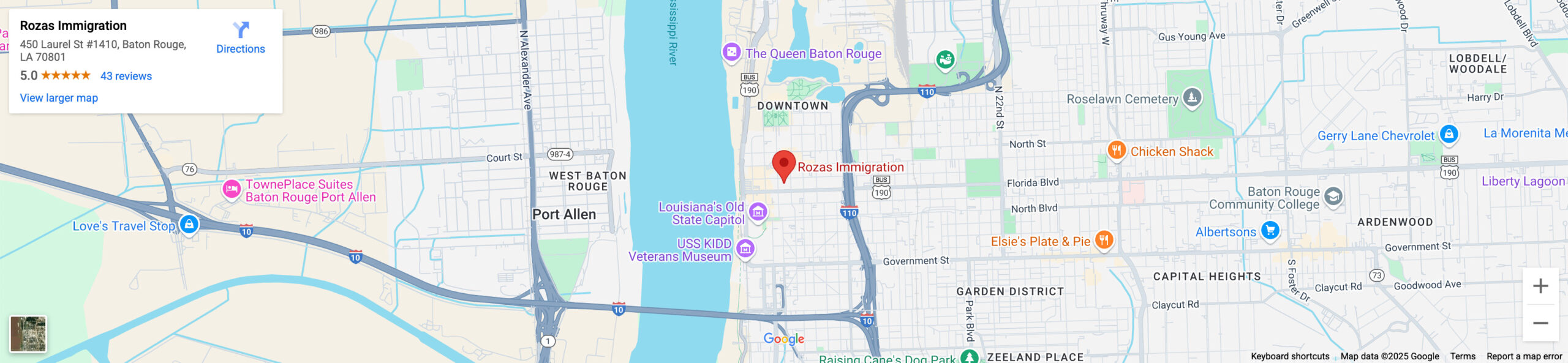
Rozas Law Firm handles immigration court asylum cases out of Baton Rouge, Louisiana, and appears in proceedings throughout the Fifth Circuit. Attorney David Rozas and the firm’s team also practice criminal defense and family law, which matters more than clients expect, because a criminal charge can reshape an asylum case overnight.
If you received a referral notice, a Notice to Appear, or a hearing date, the worst thing you can do is wait and see. The window to gather country conditions evidence, obtain documents from abroad, and reconcile your record is open right now, and it closes.
Call Rozas Law Firm to schedule a consultation.